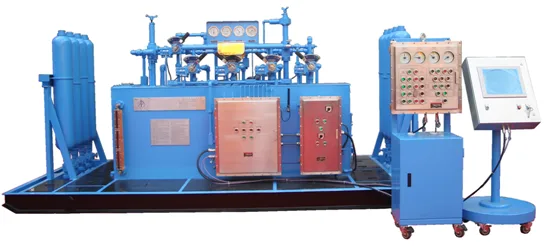
Annular and ram blowout preventers, API 16D control systems and wellhead assemblies for pressures to 70 MPa, with NACE-compliant trim for sour service.
Pressure control equipment has one job: close the well when something goes wrong, and open it again when the crew is ready. Everything else is detail. We build the closure side — annular and ram preventers, rotating preventers for underbalanced work, and diverters for shallow formations — and the control side that drives them, including the accumulators, manifolds and panels that decide how fast and how reliably the rams move.
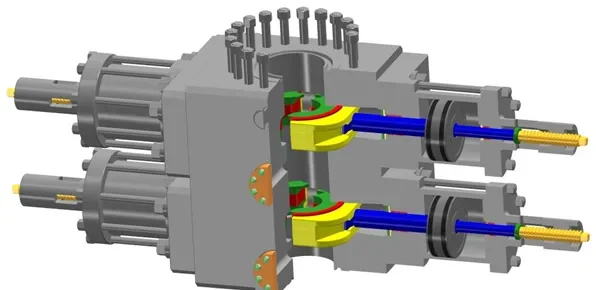
Annular preventers come in three body styles (A1, A2 and D), each with a different seal geometry for the pressure and tool-joint range involved. Ram preventers come in four variants — RSC, RSF, RSL and RSH — covering single, double and triple ram stacks. The rotating preventer XF35 handles underbalanced drilling with two-stage rubber sealing, a quick-assembly stuffing box, pressure-lubricated bearings and a cylinder-controlled hub that opens and closes around the string. A 29 in, 500 psi diverter completes the shallow-well set.
On the control side, the FKQ series follows API 16D, which BOMCO holds as a monogram licence. Each unit carries two independent power sources, accumulator bottles sized so that one bottle failure costs no more than 25 percent of total volume, and optional nitrogen backup for closing the stack when pump capacity is lost. Air and manual pressure regulators, remote and auxiliary panels, pressure compensation on annular lines, alarms and heated or air-conditioned enclosures are all available per site conditions.
A blowout preventer stack is only as good as the pressure control driving it, so we quote the two as one item: the ram and annular blowout preventers, the choke and kill manifold, the accumulator unit and the panel that ties them together. Pressure control testing happens with the accumulator charged as it will be installed, and the record goes to site with the stack. Where the well calls for a rotating blowout preventer, the same control unit drives it, which keeps one panel and one procedure in the doghouse.
We build the closure and the control unit in the same plant, and test the stack with the accumulator set as it will be installed.
Well Control
Well Control
Wellheads
From the well's maximum anticipated surface pressure and the largest tool that must pass through. A 7 1/16 in, 70 MPa stack covers most development wells; exploration wells in high-pressure zones often move to 11 in.
The code reads product type, bore size and rated working pressure. FH marks an annular preventer with spherical packing, FZ a single ram, 2FZ a double ram, 3FZ a triple ram, and SFZ a manually operated ram.
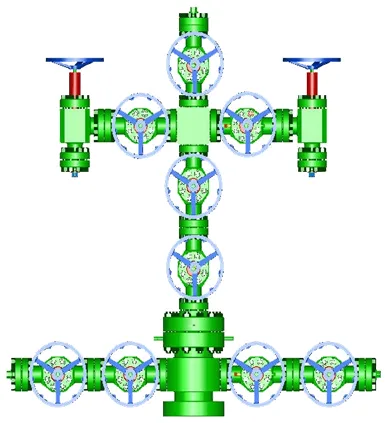
Wellhead assemblies for H2S duty are built with NACE-compliant trim; material certificates are issued with the unit.
Function testing of each rams and the accumulator precharge is normally done before shipment and again at rig-up. Site procedures follow the operator's well control policy.
We select body style, trim and packing from your pressure class, fluid and sand load. If the service is sour or the choke sees continuous abrasion, we quote the upgraded trim instead of the standard one.
Pressure control is specified from the well, not the catalogue: the maximum anticipated surface pressure sets the working pressure class, the wellbore and the string set the bore, and the service conditions set the material. Sour service moves the whole stack to NACE-compliant trim with certificates traceable to the heat number.
API 16A governs the annular and ram preventers, API 16D the control systems, API 6A the wellhead and tree, and API 16C the flow iron and manifolds. We build the closure and the control unit in the same plant, and test the stack with the accumulator set as it will be installed on site.
We hydrotest every pressure-retaining body we machine, and our test records travel with the stack rather than sitting in an office file. Where a project requires third-party inspection, the works accommodates the inspector's hold points instead of scheduling around them.