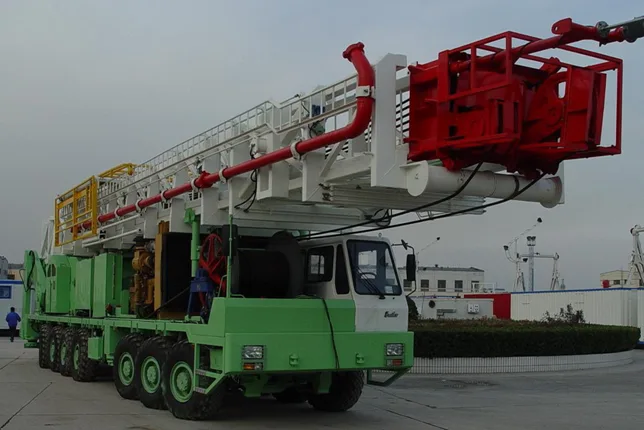
Self-propelled workover rigs rated 900–2,250 kN for pulling, swabbing, recompletion and pump changes, with telescoping masts.
Workover economics come down to how fast a rig can move between wells and how little it costs while sitting on one. Our self-propelled series carries a hook load from 900 to 2,250 kN, enough for pulling tubing, swabbing, running ESPs, changing pumps and light recompletion on land wells — with the mast, substructure and carrier on one chassis so the rig travels as a single permitted vehicle.
The mast is a two-section telescoping mast raised and extended by hydraulic cylinders. Sitting on the carrier rather than on a separate trailer keeps the centre of gravity low for road travel and gives the mast a wide base when working. The substructure is either the rotary-lift or vertical-lift type, which cuts rig-up time and the number of transport loads; the ramp and catwalk are built as one unit so the pipe path stays clear during both operations and moves.
Drawworks run as single- or double-drum units with band or disc main brakes and a water-cooled rotor or disc auxiliary brake. Carrier chassis meet road regulations for axle load and visibility, and are specified for continuous heavy-duty service rather than occasional hauling, which is what separates a workover rig from a truck with a mast bolted on.
We keep the mast, the carrier and the drawworks in one engineering file, so the travel height and the working height are settled together.
Workover Rigs
Start from the heaviest string you expect — tubing plus rods plus fluid — and add 25 to 30 percent for overpull. A 1,500 kN rig normally covers 3 1/2 in tubing to about 3,000 m.
Yes. The mast height and hook load cover standard ESP assemblies, and the catwalk is wide enough for cable spooling.
A workover rig is built for tripping and light circulation, not for making hole. It carries no top drive or mud system, travels as one vehicle, and rigs up in hours rather than days.
We build workover packages around your completion string, wellhead height and the roads you actually drive. Tell us the tubing size and mast clear height and we will return a mast and substructure layout.
Workover economics are decided by hook load, mast height and move time rather than by the pump or the rotary. We start from the heaviest string the well will see, add the mast height needed for the longest joint in the area, and then check the resulting envelope against the roads the rig will actually use.
API 4F covers the mast and substructure, API 7K the hoisting and rotary equipment, and API 16A the pressure control for live-well work. A workover rig that will nip up on a live well needs the BOP and the kill line designed in, not added from a second supplier later.
We measure the travel envelope against local road rules before quoting, and we hand our drawings to the transport contractor so the permits are applied for against a real dimension set. Service is quoted with the first year of spares, because a workover rig standing idle costs more per day than the part that failed.