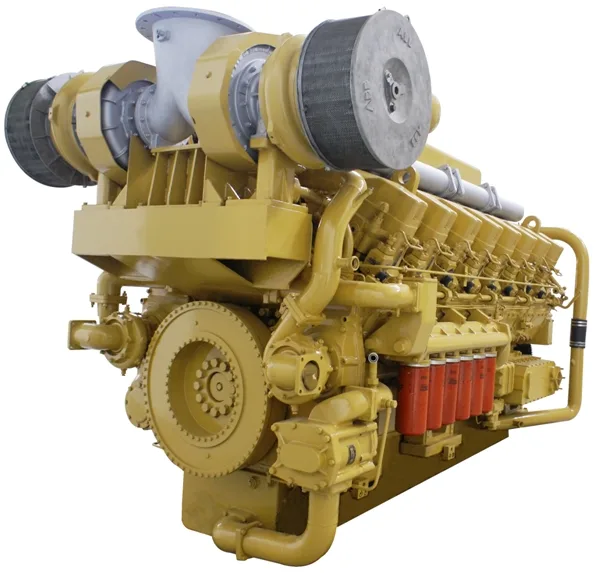
Power generation on a rig is an engine with a derrick attached, and the engine decides how much of the day is actually spent drilling.
The 190 series covers the power generation requirement from 110 kW to 2,400 kW in naturally aspirated, turbocharged, dual-fuel and gas versions, with land and marine builds sharing liners, pistons and valve train so a fleet can hold one spares set instead of three.
The larger frames were modelled before they were cast. Combustion, crankshaft torsional behaviour, turbocharger matching and gas exchange were simulated first, which is how a 190 mm bore reaches 2,400 kW without the cut-and-try that used to accompany a new frame. That work also explains why the B3000 was reworked around sealing, service access and automation for unmanned wellsites rather than around output alone.
Where the load is continuous and gas is available, the 26/32 medium-speed family takes over: a 260 mm bore, 320 mm stroke engine built in gas and diesel versions on the same block, with lean-burn combustion at a controlled excess-air ratio, two-stage charge air cooling and per-cylinder injection trim. It drives pipeline compressors, platform power and captive plants, where fuel cost and emissions decide the project rather than engine price.
Around the engine sit the transmission and the electrical package: YOT and YOCQH hydraulic couplings and coupling gearboxes from 1,600 to 8,000 kW, JC15 generator sets, and low-voltage assemblies including MNS, GCS, GCK and SIVACON 8PT with KYN28-12 metal-clad gear. Platform power usually comes from a 26/32 medium-speed engine running on associated gas, which is why the genset is specified with the rig package.
We build the engine and the generator set on the same line, so alternator, coupling and panel are matched before the unit reaches site. Our engineers set the fuel map at commissioning against your gas analysis, we train the crew on the governor, and we keep top-end parts for that frame in stock. We keep the commissioning report on file, and our spares list follows the build that was actually shipped. Power generation packages are quoted with the switchgear, because an engine that suits the load and a panel that does not is a commissioning delay.
Fuel logistics decide it. A rig that moves every few weeks with no gas line stays on diesel; associated gas makes dual fuel the practical middle; a steady supply at a fixed location justifies spark-ignition gas.
One frame, one crankshaft, one alignment to hold and no coupling to wear out. That is why the arrangement is chosen for wellsites nobody visits every day.
The engine, mainly. A mud pump stall or bit seizure produces a torque spike that a direct drive passes straight to the crankshaft; the coupling absorbs it and limits the torque the shaft sees.
Not reliably. Water, condensate and sulphur compounds have to be handled before the mixer, and the derating follows the gas analysis rather than the sales sheet.
Power and Drive carries the main duty, 26/32 Medium-Speed Engines covers the pressure side, and we quote the three as one scope where they meet on a location.
Product line
System
System
Product line
Power generation on a rig is an engine with a derrick attached, and the engine decides how much of the day is actually spent drilling.