The casing and tubing string touches everything: the reservoir, the mud, the pressure and the rig floor. It is specified by what it has to survive, not by diameter alone.
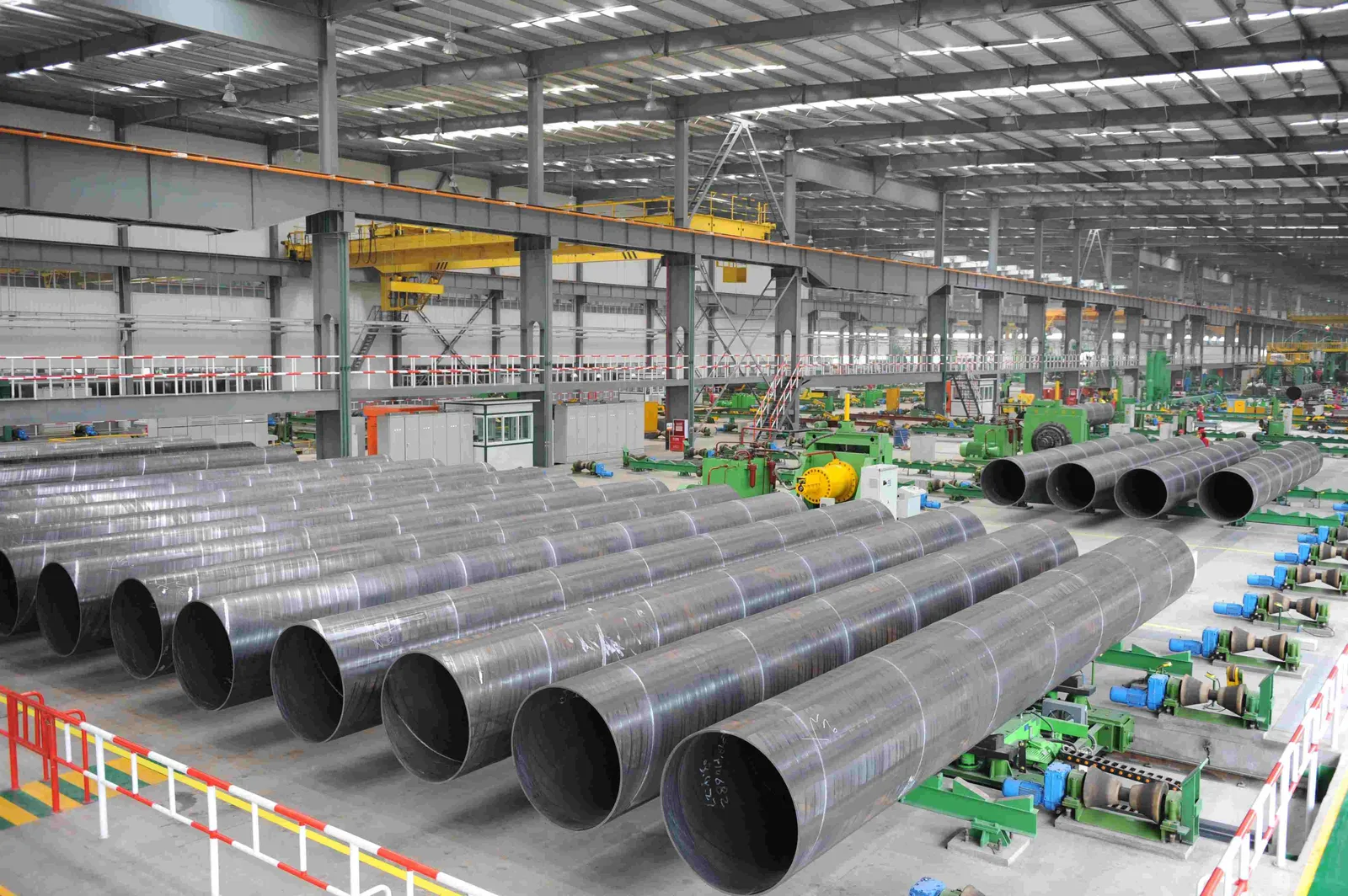
Line pipe leaves the works from two mills: a spiral SAW line running API 5L and GB/T 9711 grades in heavy wall, and a large-diameter longitudinal SAW line formed on SMS Meer equipment and finished with five-wire welding. The difference matters in service. A spiral seam spreads around the circumference and holds dimensional accuracy on large diameters; a straight seam is short enough to radiograph in the mill and to re-check on site after expansion has left residual stress low and evenly distributed.
For the well itself, casing and tubing are produced to API 5CT and 5B in seamless and HFW, in API and non-API sizes. Grade selection is driven by collapse and burst rather than by habit: J55 and K55 cover shallow, moderate-pressure strings, N80 covers most development wells, and L80 or P110 come in where pressure, depth or CO2 service demands them. The string is completed with the lift method, and an electric submersible ESP system needs a cable clamp on every joint and a seal section sized to the casing, which is why the two are specified together.
The drillstring is the other half: drill pipe to API 5D in E75, X95, G105 and S135, and collars to API 7 from AISI 41545H and non-magnetic alloy. Tool joints, hardbanding and internal coating are specified together with the pipe because they decide the connection life, not the pipe body.
Documentation travels with the order: mill certificates, heat numbers and test reports, so the operator can close the well file without a second shipment of paperwork.
We issue mill certificates, heat numbers and test reports against the order, so the well file closes without a second shipment of paperwork. Our inspectors witness the hydrostatic test when the contract asks, we keep connection data on file, and we trace any joint back to its heat. When you re-order from that file, we quote the same heat and the same connection without asking twice. Tubular orders are quoted with the connection, because the joint usually decides the string before the pipe body does.
Spiral where the diameter is large and dimensional accuracy plus circumferential strength matter; straight seam where the weld has to be radiographed in the mill and re-checked on site after expansion.
Expansion leaves residual stress low and evenly spread, which is what resists stress-corrosion cracking and keeps ovality good enough for reliable field welding.
For a lot of casing duty it is, because hot-rolled strip is finer grained and denser than a pierced billet. Collapse and burst against the actual load decide the service, not the route the pipe was made by.
Tubular Products carries the main duty, High Pressure Flow Control covers the pressure side, and we quote the three as one scope where they meet on a location.
Product line
Product line
Product line
Product line
The casing and tubing string touches everything: the reservoir, the mud, the pressure and the rig floor. It is specified by what it has to survive…