What the source and the sensor do at the ground sets the ceiling on everything the processing centre can recover later.
Crews face three source problems, and the range here covers each of them: vibroseis where explosives are not permitted or terrain is too accessible for shot holes, an impulse source for shallow and VSP work, and shot-hole rigs for swamp and mountain terrain no truck can reach.
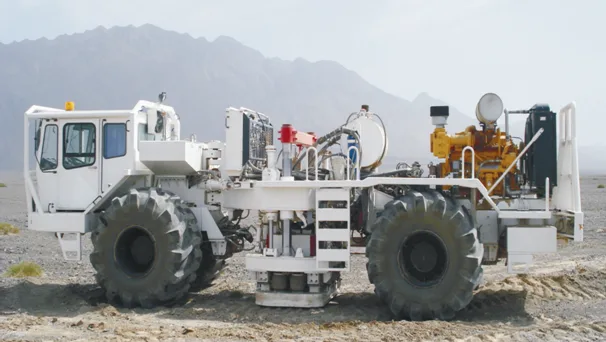
A vibroseis truck is a weight problem in disguise: the base plate has to stay coupled while the sweep runs, and that coupling comes from wide tyres, a low centre of gravity and a stiff frame. The KZ-28 is specified for desert, swamp and town work on that basis; the KZ-34 adds two-guide-post lifting and a 4x4 chassis for gobi and piedmont tracks. Inside the vibrator housing, a transverse servo valve and bladder accumulator keep the response fast and the distortion low.
Sensors range from the SN7C and XTJ land geophones through the HYD shallow-water piezo unit to the GH203 gimbal and DBSL dual-sensor seabed units. The dual-sensor unit measures velocity and pressure in the same housing, which allows the receiver ghost to be separated from the data — the thing that makes deep-water seabed records usable.
Positioning closes the loop: BPS acoustic secondary positioning keeps bottom-cable nodes located, and the JC2000 element tester checks strings before the crew deploys them rather than after a lost day.
We supply source, sensor and positioning from the same works, so a crew is not left matching three vendors' timing conventions. Our engineers support the first crew in the field, we test the geophone strings before deployment, and we keep spares for those strings in the region.
Explosives are ruled out by permitting, QHSE rules or a town close to the line, and vibroseis also suits targets deep enough to justify a long sweep. Shallow refraction, VSP, micro-logging and coal-bed methane work go to the impulse source instead.
They decide where the truck can go at all. Dunes, swamp edges and town streets all carry load limits, and traction decides whether it comes back out. That is an acquisition constraint before it is a comfort feature.
Two measurements in one housing let the receiver ghost be separated from the record. Without that separation, deep-water seabed data stays noisy enough that no processing centre can recover the bandwidth.
Seismic Equipment carries the main duty, Seismic Recorders covers the pressure side, and we quote the three as one scope where they meet on a location.
Product line
System
System
Product line
What the source and the sensor do at the ground sets the ceiling on everything the processing centre can recover later.