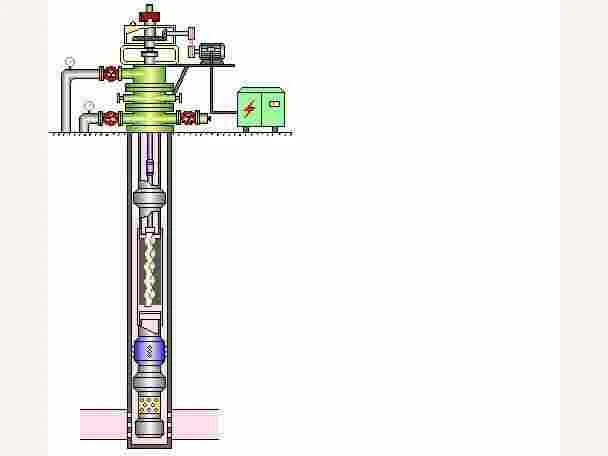
Progressive cavity pump systems for viscous, sandy and dewatering wells: rotor and stator matched to the fluid, surface drive head sized to the torque.
The pump, the drive head and the motor are quoted as one system; the rows below describe what is fixed and what is chosen per well.
Figures taken from the PCP Screw Pumps (Progressive Cavity) data sheet issued by BOMCO. Values are nominal and the quotation confirms the build for your order.
A progressive cavity pump moves fluid in sealed cavities that travel from intake to discharge as the rotor turns inside the elastomer stator. The flow is steady, the shear is low, and there is no valve to ball up, which is why the pump suits heavy oil, sand-laden production and coal-bed methane dewatering.
The downhole assembly is only half the system. The surface drive head decides how the pump behaves: gear ratio, polished rod load, stuffing box and the brake that holds the string when the motor stops.
We match rotor and stator as a pair and record the fit, so a stator ordered a year later still suits the rotor already downhole. Our drive heads are sized from the torque the well actually demands, with a margin for a settled column at start-up. On a well with no maintenance crew we would not propose a belt drive, and we will tell you that at the enquiry stage rather than after the first failure. Give us the torque requirement and the gearbox and brake come back matched to it. We keep the pair record on file, so our replacement stator suits the rotor already in the well. We would rather quote a slower pump that lasts than a fast one that eats stators.
Viscous oil, high sand cut, low API gravity and wells with a modest inflow. The screw pump tolerates solids and gas slugs that would shorten the life of a centrifugal stage, and it produces at low speed without a separator.
From the torque the rotor needs at the design speed and the rod string weight, with a margin for start-up against a settled column. The gearbox rating and the brake are fixed from those two numbers, not from the motor frame.
Yes. The stator is a separate component; with the rotor pulled, a new stator is fitted on the same tubing. We supply the elastomer grade for your fluid so a replacement matches the first one.
Rotor and stator are matched as a pair and dimensioned in one record, so a replacement stator ordered months later still fits the rotor in the well.
The drive head, polished rod and wellhead adapter arrive as one assembly, which keeps the install to a lifting and alignment job.
A progressive cavity pump manufacturer usually sells the pump alone; we quote the PCP pump oil well operators actually need together with the PCP surface drive head, because the two decide the torque the string sees.
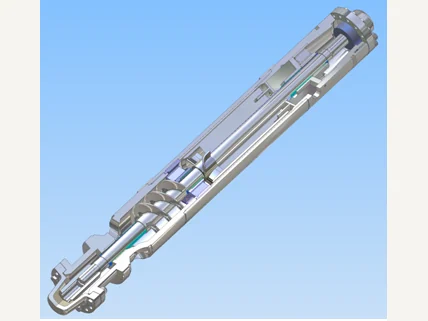
Artificial lift system