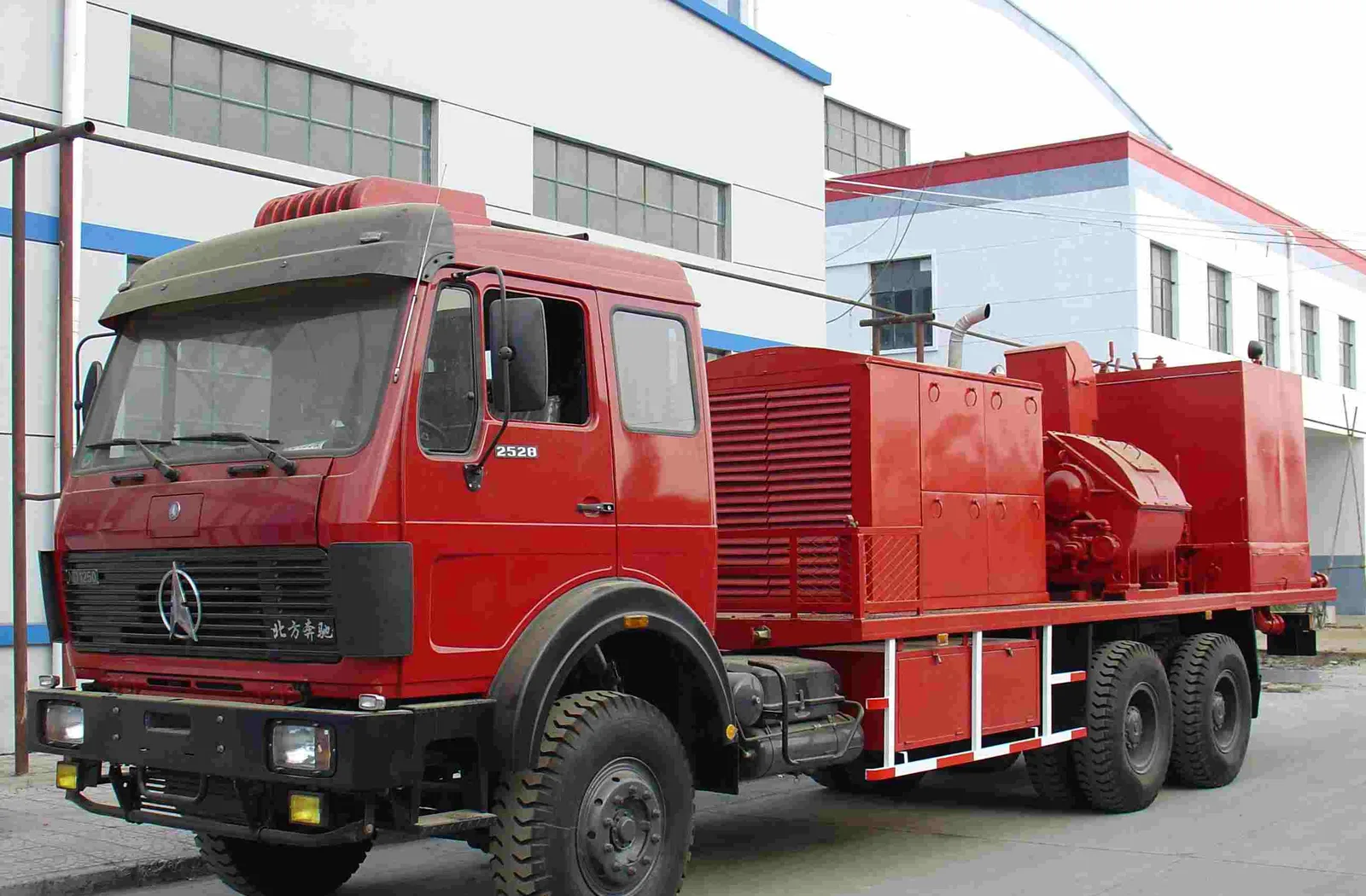
We size a cementing spread by the volume it has to mix and the rate it has to displace at. The number of units follows from the casing programme.
Work the slurry volume first. A 9 5/8 inch casing in a 311 mm hole, run to 2,400 m with a 500 m shoe track, takes roughly 62 m3 of lead slurry and 18 m3 of tail slurry. Add 15 percent for hole enlargement and losses, and the job is about 92 m3. That is the number the bulk truck has to deliver, not the cement sack count.
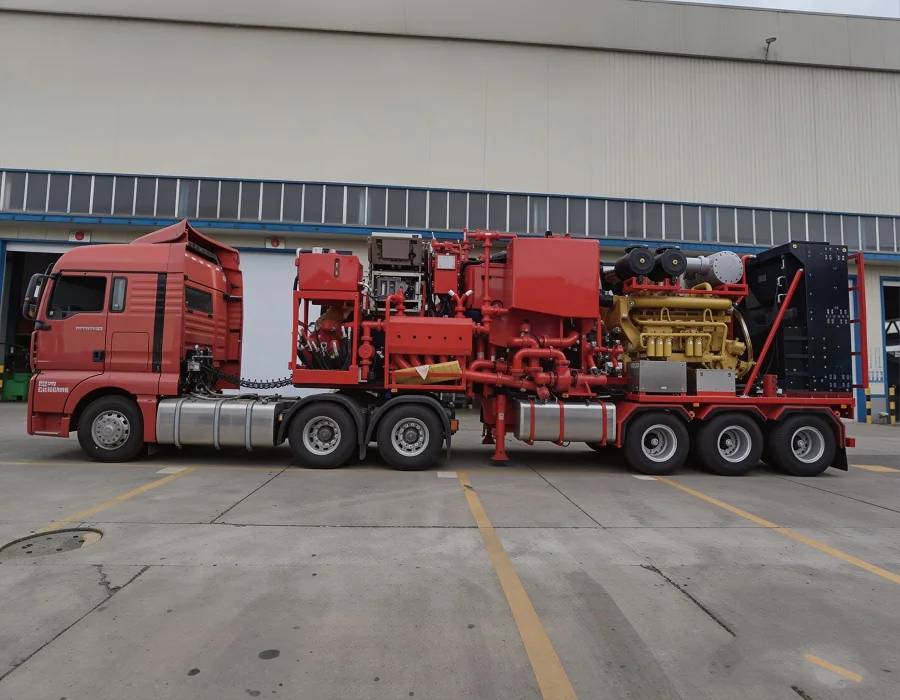
Displacement rate sets the pump, not the volume. Plug flow in the annulus needs 0.6 to 1.2 m3/min in a 311 mm hole; below that the slurry channels and the top of the cement does not reach the shoe. One triplex pump at 1.0 m3/min over 92 m3 is a 90 minute job plus mixing time, which is why most land jobs run a single unit with a recirculating mixer rather than two units in series.
| Casing, mm | Hole, mm | Depth, m | Slurry, m3 |
|---|---|---|---|
| 508.0 | 660.4 | 120 | 18 - 24 |
| 339.7 | 444.5 | 600 | 30 - 38 |
| 244.5 | 311.1 | 1,800 | 55 - 70 |
| 177.8 | 215.9 | 3,200 | 32 - 42 |
| 127.0 liner | 152.4 | 1,200 | 8 - 12 |
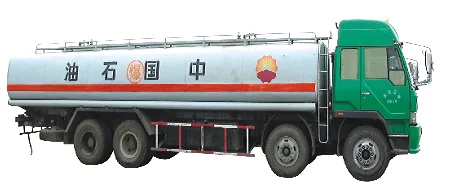
Tank trucks are the other half of the spread. Water for mixing is 0.44 to 0.50 m3 per m3 of slurry at 1.8 g/cm3, so a 92 m3 job needs about 42 m3 of water on location before the first sack is cut. A tank truck that holds 20 m3 means three trips, or two trucks standing by.
The check we see missed most often is the density measurement point. A recirculating mixer with a densimeter on the discharge line gives a continuous reading; a batch mixer gives a reading after the fact. For a job above 80 m3, we would pay for the continuous reading because a density excursion in the lead slurry is not recoverable after the plug is bumped.
Model
Model
Application
Service
We would send two for a single job with a 20 m3 capacity per truck and a 30 minute round trip to the silo. One truck works only when the silo is on location.
0.6 to 1.2 m3/min in a 311 mm hole. Faster risks fracturing the formation; slower allows the slurry to channel and the shoe track to be contaminated.
Above roughly 80 m3 of slurry, yes. It holds density within 0.05 g/cm3 through the job, where a batch mixer drifts as the job runs long.
About 0.45 m3 per m3 of slurry at 1.8 g/cm3, plus 10 m3 for flushing. A 90 m3 job needs roughly 50 m3 of water before the job starts.
We size a cementing spread by the volume it has to mix and the rate it has to displace at. The number of units follows from the casing programme.