We start from the measurement the reservoir answer needs, then remove tools by borehole size, temperature and whether the string goes on wireline or behind the bit.
Name the answer before naming the tool. Water saturation needs resistivity and porosity; a completion decision needs a caliper and a cement bond; a geosteering decision needs resistivity at the bit and an inclination measurement close to it. The strings we assemble usually carry four to six tools, and the combination has to share a telemetry budget and a borehole diameter.
Borehole size removes tools quickly. An 8 1/2 inch hole takes the full array suite; a 6 inch hole removes the larger imaging tools and the sidewall corer; a 4 3/4 inch hole leaves a slim string of resistivity, porosity and natural gamma. Temperature does the same: a 150 C well removes the tools rated to 125 C, and a 175 C well usually requires a dewar-flasked tool section.
| Measurement | Borehole, mm | Temperature, C | Delivery |
|---|---|---|---|
| Array induction | 150 - 400 | 150 | wireline |
| Array laterolog | 150 - 400 | 150 | wireline |
| Multipole sonic | 150 - 400 | 150 | wireline |
| Microresistivity imaging | 150 - 400 | 125 | wireline |
| Ultrasonic imaging | 140 - 400 | 150 | wireline |
| Cased hole resistivity | 60 - 250 | 150 | wireline |
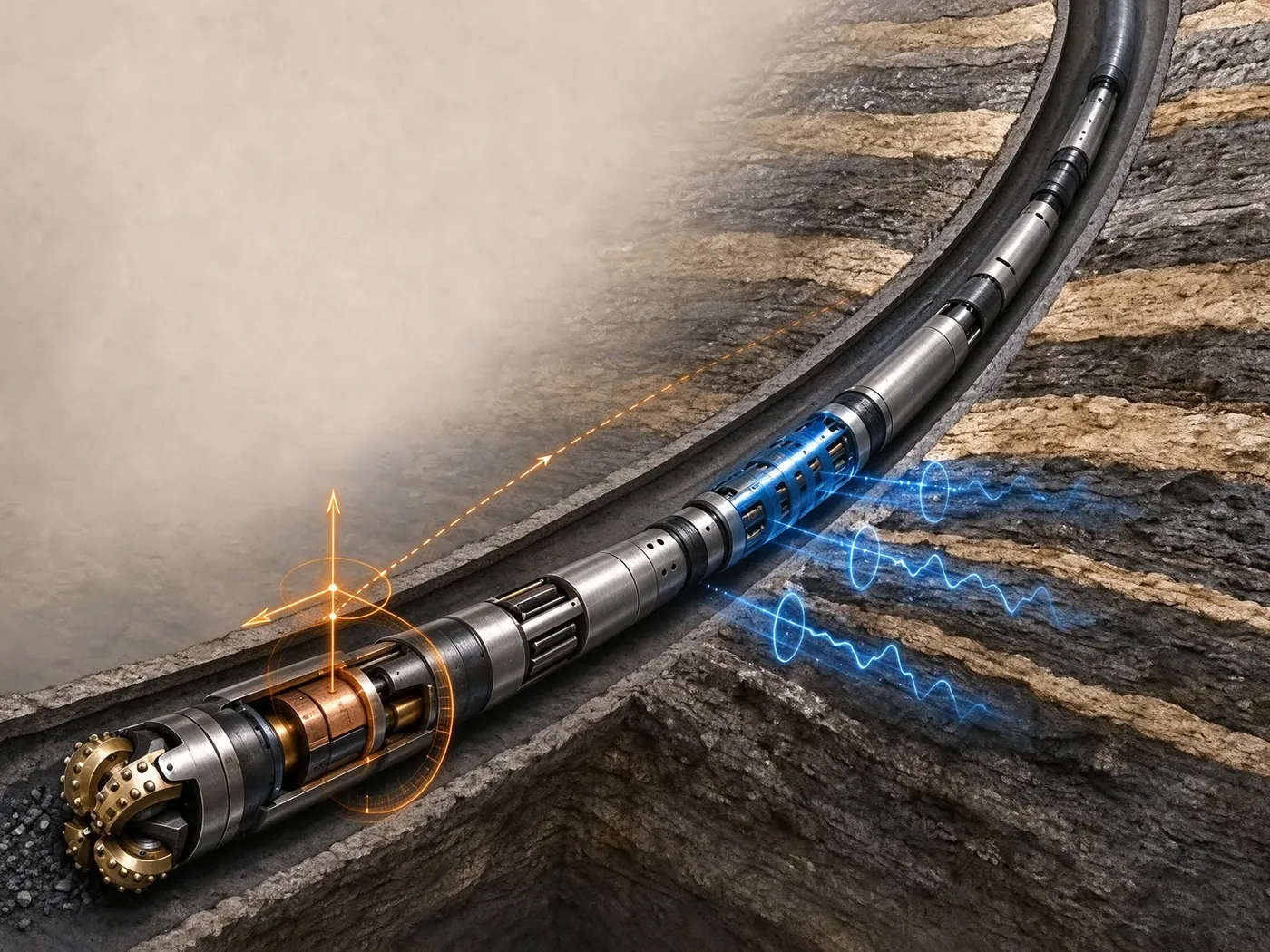
| Directional LWD | 170 - 250 | 150 | while drilling |
| Azimuthal gamma LWD | 170 - 250 | 150 | while drilling |
LWD or wireline is a cost-and-access decision. Wireline gives a complete suite with a defined depth reference and a repeat section for quality control; LWD gives the measurement in real time and removes the need for a logging run in a hole that will not stay open. The usual compromise is LWD for geosteering plus a wireline suite at total depth for the full formation evaluation.
On our jobs the surface system matters as much as the tools. A platform that records four to six tools at 200 m/min with depth encoding and a real-time feed is what makes the string usable; a platform that records two tools and needs a separate depth pass turns a six hour job into a twelve hour one.
We would run LWD in the horizontal section, because the string has to steer and a wireline run in a long lateral is slow and risky. A wireline suite is still worth running in the vertical section for the full formation evaluation.
Four to six in a normal 8 1/2 inch hole, limited by telemetry bandwidth, string length and the clearance in the borehole. A slim 4 3/4 inch hole carries three.
At least 25 C above the expected bottom-hole temperature. A tool rated at 150 C in a 150 C well is operating at its limit through the whole run, not with margin.
Yes. Depth encoding, real-time display and the export format decide whether the data is usable by the client's interpretation software without a manual conversion.
We start from the measurement the reservoir answer needs, then remove tools by borehole size, temperature and whether the string goes on wireline or…