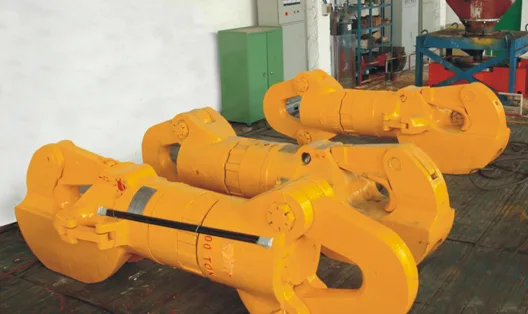
Traveling hooks to API 8A and 8C with hydraulic cushioning in the barrel, 45-degree locking over a full turn and alloy-steel load path verified.
The hook is the last link between the rig and the string, and the one component a crew touches on every trip. It has to swing freely, lock positively and absorb the shock that comes when a stand of pipe is picked up too fast. Our hooks are built to API 8A and 8C and to SY/T 5527, with the API monogram on the nameplate.
The barrel is designed so the oil inside acts as a hydraulic cushion between the barrel and the hook body: impact energy from pickup and set-down is absorbed by fluid flow rather than by the structure. A braking mechanism locks the hook body at 45-degree intervals through a full 360-degree rotation, which lets the crew position the elevators without fighting the hook. A safety latch on the body prevents the swivel bail from slipping out.
Load-carrying parts are high-strength alloy steel, and each is checked by non-destructive testing before assembly. That matters because hook failures are almost never sudden — they start as a crack in a part that was not inspected.
We keep hook bodies and latches in stock for the models in service, because a latch is what stops a string when the crew is in a hurry.
Traveling Hooks
The range matches the traveling block and crown block sets, so a hook is normally chosen as part of a matched hoisting package rather than on its own.
The locking mechanism allows positioning when the string is suspended, but the hook should be locked before load is applied.
Visual inspection of the latch and body each tour, with periodic non-destructive testing of the load path per the operator's lifting policy.
We quote hooks by working load, opening size and the elevator links they will carry. Our engineers check the hook against your existing block before release, so two suppliers' hardware still latches.
Hook selection follows the same load case as the block: maximum string weight, the number of lines and the derrick height available. The differences that matter in service are the cushioning in the barrel, the latch geometry and how the hook behaves when the crew is in a hurry.
API 8A and 8C govern the design and the load rating. Our hooks carry hydraulic cushioning, 45-degree locking and a latch that opens under load without binding, and the body is inspected before assembly rather than sampled after it.
We keep hook bodies and latches in stock for the models in service, and we stamp the serial number where inspection can still read it. Recertification is a scheduled task on a drilling rig, and it should not depend on finding a part.