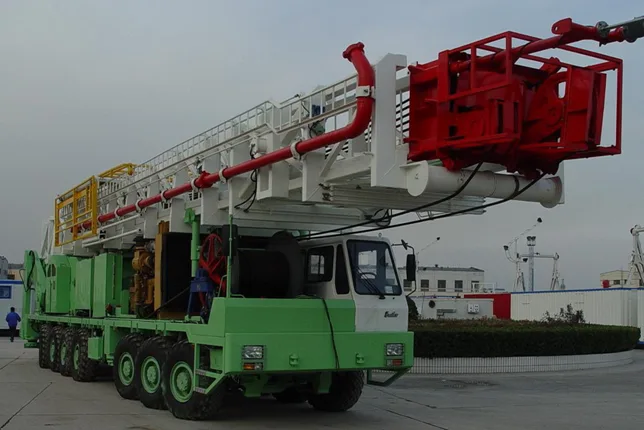
Workover economics come down to how fast a rig moves between wells and how little it costs while sitting on one.
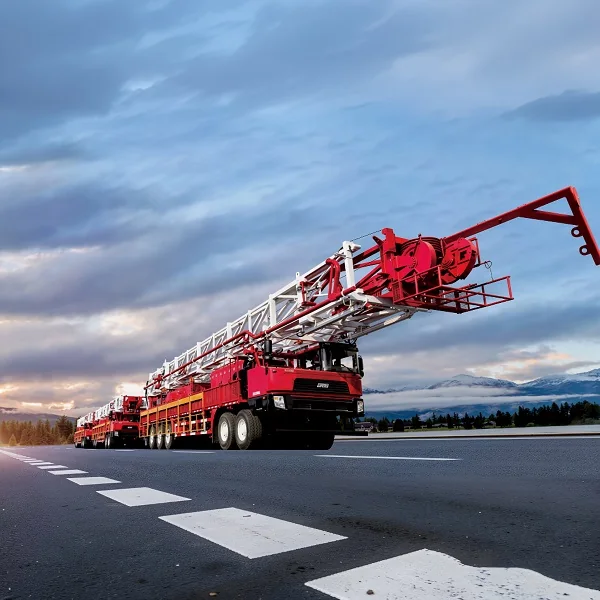
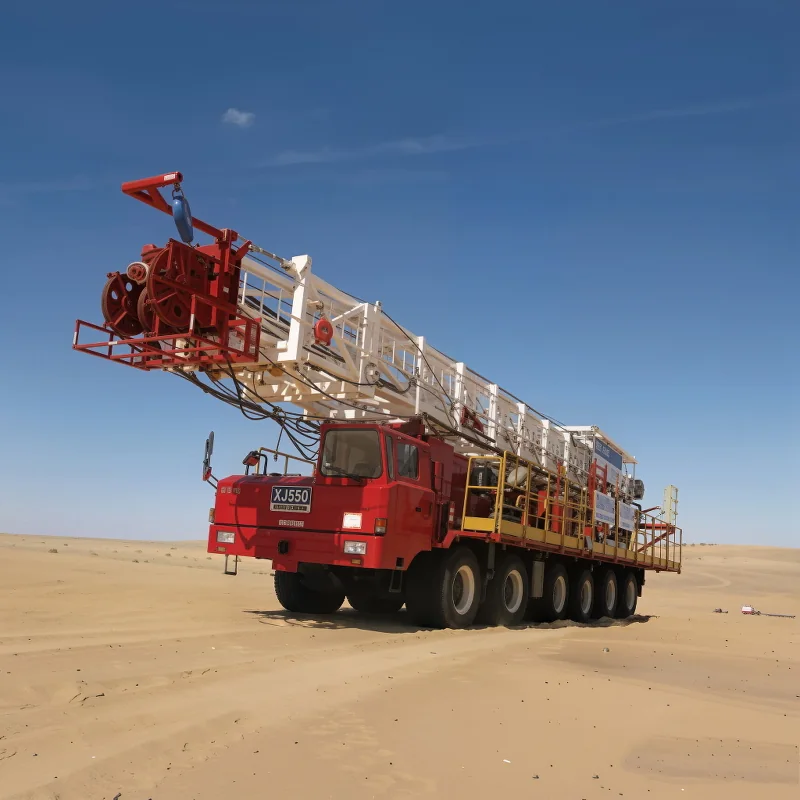
A workover spread that takes a day to rig up loses the job to a spread that takes four hours, even if its hourly rate is higher. The self-propelled series is built around that arithmetic: mast, substructure and carrier on one chassis, travelling as a single permitted vehicle, with a two-section telescoping mast raised and extended hydraulically. The unit described is a workover rig in the narrow sense: mast, substructure and carrier on one chassis, rated for the hook load on the drawing.
Hook load runs from 900 to 2,250 kN, enough for pulling tubing, swabbing, running and changing ESPs, changing pumps and light recompletion on land wells. Sitting on the carrier rather than on a separate trailer keeps the centre of gravity low for road travel while giving the mast a wide base when working. Ramp and catwalk are built as one unit so the pipe path stays clear during both operations and moves. The hook above it is an API 8C traveling hook, and we match it to the block so the sheave and bearing sets interchange between units.
Not every job needs pipe. Where the work is circulation-based — sand bridges, scale, wax and hydrate plugs, well killing, nitrogen lifting — a coiled tubing unit does the job in a shift and leaves the workover rig for the wells that genuinely need tripping. The two are quoted together often, because the split between them decides the annual spread count.
We quote the rig with mast, carrier and pump as one unit, so the hook load on the drawing is the hook load on the well. Our engineers commission the first unit on site, we train the crew on the controls, and we hold the wear parts for that model in stock.
Start from the heaviest string expected — tubing plus rods plus fluid — and add 25 to 30 percent for overpull. A 1,500 kN rig normally covers 3 1/2 in tubing to about 3,000 m, which is the common land case in mature fields.
Yes. Mast height and hook load cover standard ESP assemblies, and the catwalk is wide enough to spool cable. What decides the job is cable handling and the workover schedule, not the rig rating.
When the work is circulation-based rather than pipe-based: sand and scale cleanout, milling, well killing, nitrogen lifting. A CTU rigs up in a shift and does not need the pipe to come out at all.
Workover Rigs carries the main duty, Coiled Tubing Units covers the pressure side, and we quote the three as one scope where they meet on a location.
Product line
Product line
Product line
Product line
Model
Workover economics come down to how fast a rig moves between wells and how little it costs while sitting on one.